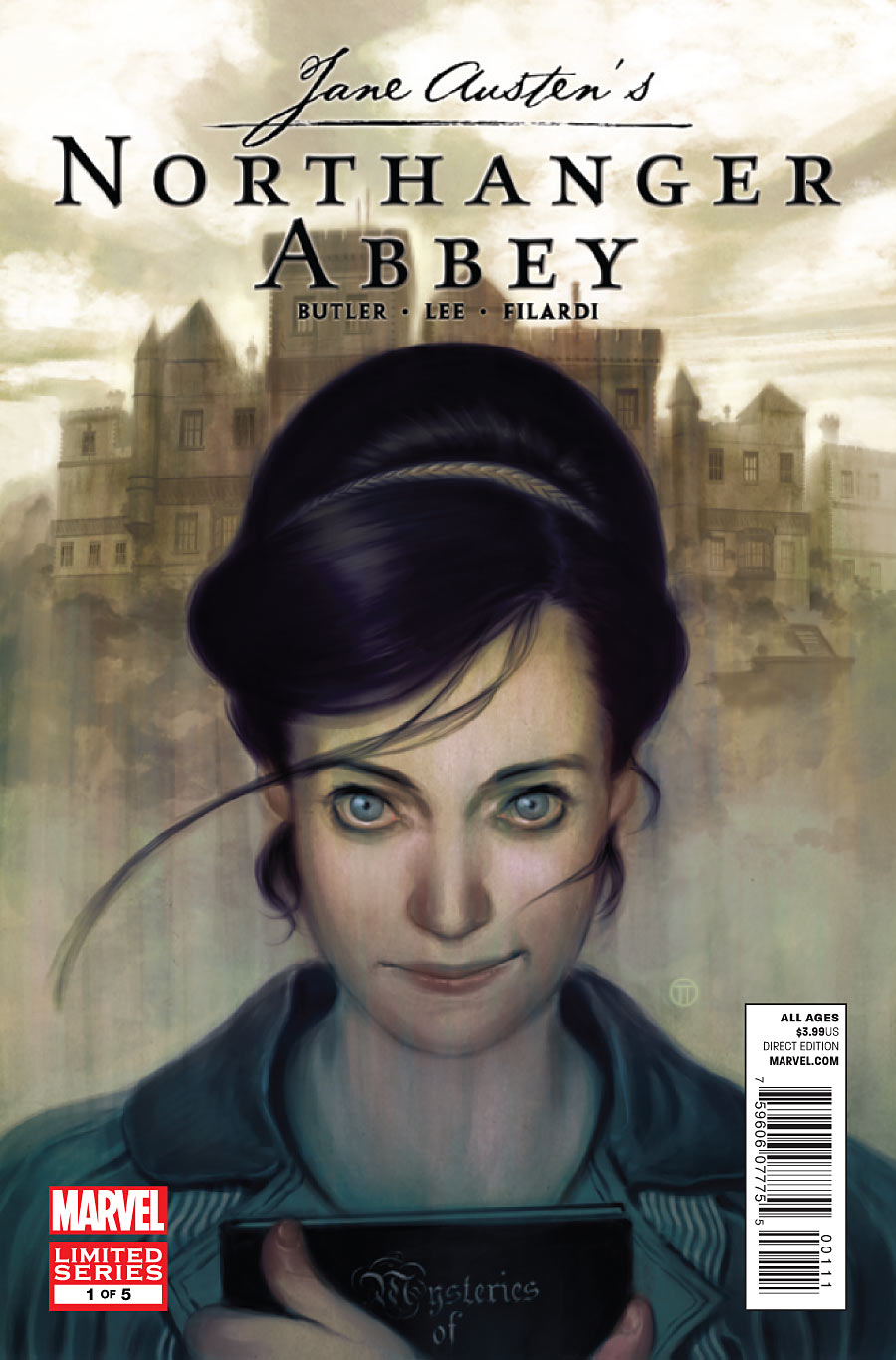
Showing posts with label Northanger Abbey. Show all posts

Wednesday, March 7, 2012

'Northanger Abbey' Quiz Answers


Well, I see that someone out there has done their homework!  Way to go! Pat yourself on the back - you are the only persons brave enough to answer all 18 questions of the quiz (let alone one). Some of the answers in the book may vary a bit, so here they are. (Taken from So You Think You Know Jane Austen?: A Literary Quizbook by John Sutherland & Deirdre Le Faye.)

1) Q. How many children do the Reverend Mr and Mrs Morland have? How many of their Christian names do we know?

A. The Moreland's have 10 children. At the beginning of the narrative Catherine is 17 (18 when she marries). She has 3 older brothers, James (about 22), Richard (about 20), and a third, unnamed (about 18). Sarah ('Sally') is 16. When Catherine returns to Fullerton and the end of the novel we are briefly introduced to the two youngest of the family, George (6) and Harriet (4). There are 3 unnamed boys between Sally and George (we assume they are boys because they are away at school).

2) Q. Where did Henry go to university?
A. Oxford. But he in no way resembles his fellow Oxonian, Thorpe.

3) Q. What are the 'friends of Henry's solitude' at Woodston?
A. 'A large Newfoundland puppy and 2 or 3 terriers'

4) Q. What aspect of Catherine's walk does General Tilney particularly admire?
A. The elasticity, meaning Catherine's gait is springy, lithe, light-footed.

5) Q. What do we know of Henry's complexion and what does this mean?
A. He has 'brown skin, with dark eyes, and rather dark hair'. Fair and pallid complexions were more fashionable. Henry's color suggests an outdoor life. His brother, Captain Fredrick Tilney, has a florid complexion suggestive of a dissipated mode of life which his brother, Henry, avoids.

6) Q.What color dress (as Mrs Allen's needle-sharp eye notes) does Miss Tilney 'always wear'?
A. White. It means the Tilneys have a full compliment of servants. She need not wear clothes more than once before they are laundered. In Mansfield Park, Mrs Norris believes in turning away maids who presume to wear white - that colour is above their station in life.

7) Q. Who says, 'after all the romancers may say, there is no doing without money'?
A. Isabella Thorpe, gold-digger that she is.

8) Q. For what does the General rebuke Fredrick on the day the rest of the family leave Bath?
A. Being late for breakfast.

9) Q. Why, having just arrived at Bath (to arrange accommodations for himself and his father and his sister) does Henry suddenly leave, and what should we deduce from his departure?
A. He returned to Woodston to take a Sunday service, declining to leave it to his curate. His conscientiousness contrasts with that of the two truanting Oxonians.

10) Q. On the trip to Northanger Abbey we are informed that Catherine has a 'new writing desk'. What may we deduce from it?
A. She is dutifully thinking of writing letters, and, needless to say, this is a good quality in Austen's fictional world. Catherine must have bought it with money given her for clothes. Isabella, doubtless, would have not wasted her substance on a writing desk.

11) Q. Why does Catherine not, as she plans, steal out at midnight to investigate the 'mysterious apartments' in which, she is convinced, the General's poor wife is secretly incarcerated?
A. She falls asleep.

12) Q. Why does Jane Austen specifically tell us that Catherine has a 'charming game of play with a litter of puppies just able to roll about' in Henry's stable-yard at Woodston?
A. Catherine is an instinctively affectionate country-bred girl, without any squeamish fears of getting her hands or dress dirty, and Henry observes her kindheartedness.

13) Q. In the company of Henry and Eleanor, General Tilney clearly seems to think that Catherine is the Allens' heiress (basing this on John Thorpe's misinformation). Are Eleanor and Henry similarly deceived as to Catherine's wealth and handsome prospects?
A. Surely not. Eleanor would have noted Catherine's lack of valuable jewels and modest wardrobe.

14) Q. Catherine thinks Isabella is now engages to Captain Tilney and that the Captain will gallop back to his father (as James rushed back to Fullerton) for paternal permission. Henry's guess is that his brother's marrying Isabella is 'not probable'. Has he know this from the first?
A. Yes.

15) Q. Why has Catherine, even before the General's wrathful return, suggested that she should, perhaps, leave?
A. She will be intruding, she says, and intruding on the privileges of a guest. One presumes the Morlands have brought their children up to be well mannered.

16) Q. Why is Henry not at Northanger Abbey when Catherine is summarily banished?
A. It is Sunday and he is taking the service at Woodston.

17) Q. How long is it before Henry appears at Fullerton to propose?
A. Three days. He has taken a whole day to consider his rebellious action. It is a rational decision, he has, of course, his ('very considerable') personal fortune from his mother's 'settlements'.

18) Q. How long do Henry and Catherine have to wait for parental consent?
A. One year.


Sunday, February 19, 2012

A Quiz


I am of the opinion that is is time for a quiz. 'You will be quizzed  famously!' (...sorry, John Thorpe there for a minute) Are you up for a contest? Do you have sporting blood in your veins? Answer that question in the affirmative and then answer as many of the below questions as you can, and feel free you use your book.

Yes, this is an open book test. Boy, I am a nice teacher. All of these q. s pertain to Jane Austen's Northanger Abbey which some of you just read, so perhaps it's still fresh? We shall see... The contest will be open for at least a week so everyone has time to put down their most profound and scholarly answers... or whatever you've got.

All of these questions are taken from So You Think You Know Jane Austen?: A Literary Quizbook by John Sutherland & Deirdre Le Faye. And I have it, so I already know all of the answers. Yes, I looked at the back of the book. I'm sorry. Not really.


Questions:

1) How many children do the Reverend Mr and Mrs Morland have? How many of their Christian names do we know?

2) Where did Henry go to university?

3) What are the 'friends of Henry's solitude' at Woodston?

4) What aspect of Catherine's walk does General Tilney particularly admire?

5) What do we know of Henry's complexion and what does this mean?

6) What color dress (as Mrs Allen's needle-sharp eye notes) does Miss Tilney 'always wear'?

7) Who says, 'after all the romancers may say, there is no doing without money'?

8) For what does the General rebuke Fredrick on the day the rest of the family leave Bath?

9) Why, having just arrived at Bath (to arrange accommodations for himself and his father and his sister) does Henry suddenly leave, and what should we deduce from his departure?

10) On the trip to Northanger Abbey we are informed that Catherine has a 'new writing desk'. What may we deduce from it?

11) Why does Catherine not, as she plans, steal out at midnight to investigate the 'mysterious apartments' in which, she is convinced, the General's poor wife is secretly incarcerated?

12) Why does Jane Austen specifically tell us that Catherine has a 'charming game of play with a litter of puppies just able to roll about' in Henry's stable-yard at Woodston?

13) In the company of Henry and Eleanor, General Tilney clearly seems to think that Catherine is the Allens' heiress (basing this on John Thorpe's misinformation). Are Eleanor and Henry similarly deceived as to Catherine's wealth and handsome prospects?

14) Catherine thinks Isabella is now engages to Captain Tilney and that the Captain will gallop back to his father (as James rushed back to Fullerton) for paternal permission. Henry's guess is that his brother's marrying Isabella is 'not probable'. Has he know this from the first?

15) Why has Catherine, even before the General's wrathful return, suggested that she should, perhaps, leave?

16) Why is Henry not at Northanger Abbey when Catherine is summarily banished?

17) How long is it before Henry appears at Fullerton to propose?

18) How long do Henry and Catherine have to wait for parental consent?

John Sutherland & Deirdre Le Faye suggest that if you score over 15, good for you! If you scored over 10 but under 15, skim the novel again. Over 5 but under 10, reread the novel. Under 5, throw the book away and watch TV.

(aerial view of Bath)

Thursday, May 19, 2011

O, Henry

My best friend and I just finished re-reading Jane Austen's Northanger Abbey, and the thing that struck me was that more than any of her other characters JA shares Henry Tilney's sense of humor. I can readily imagine her making the same spirited and humorous replies as he makes. And, indeed, we do hear her make them in her letters. I can't imagine Henry Tilney saying anything that would displease his creator. Although, JA said that Darcy and Edmund Bertram were her favorites, I am sure she would've laughed a great deal with Henry. Perhaps that is why he is named after her favorite brother?

Thursday, December 16, 2010

Propriety's Claims on Prudence in Lady Susan and Northanger Abbey

Chapter 2: Propriety's Claims on Prudence in Lady Susan and Northanger Abbey

In this chapter Sarah Emsley contrasts JA's earliest works, Lady Susan and Northanger Abbey. The character of Lady Susan is JA's only vicious heroine, and is not a model for female virtue! Lady Susan is an epistolary novel, and we see throughout Lady Susan's correspondence that she is conniving and cares only for herself. JA as the narrator tells us at the end, "She had nothing against her, but her Husband & her Conscience." Lady Susan is humorous as JA's juvenile works, but is longer and has a more mature feel. Austen may later focus on how virtues come into conflict with one another, but in Lady Susan her focus is more on "the villainy of human nature." Lady Susan only invokes the name of propriety when it will suit her. When she wishes Reginald out of the way for a few days so that she can continue her affair with Mr Manwaring, she acts as if they are moving too fast and pretends to be afraid of displeasing her brother.

Lady Susan has an excellent command of language and uses it to get what she desires. Some critics have argued that JA shows how Lady Susan uses her power, but then abandons the idea of female power in her later works. Emsley, however, sees that in the later novels "the heroine's pursuit of virtue is a quest for a different kind of power. Given the older definitions of virtue (or vertu) had to do with strength and power, it is important to emphasize that the virtues are moral excellences, and therefore may be seen as more powerful than aggression or manipulation."

In contrast to Lady Susan, Catherine, the heroine (or "in training for a heroine") in Northanger Abbey, is quite naive. Which may be one of the reasons that she is attractive. She is artless, open, and honest. Emsley observes, "Unlike Lady Susan, she is capable of genuinely caring for other people. In the course of the novel, Catherine begins to learn the kind of prudence that propriety requires, but the natural courage it takes to be honest and open with others is hers already...Henry learns from Catherine's openness even while he teaches her to be more prudent about social life."

Catherine learns that not all sacrifices are noble (such as choosing to go with the Thorpes and her brother when she really wanted to go with the Tilneys), not all villains are obvious (e.g. John Thorpe), and not all abbeys are haunted.

Henry and Catherine have many spirited exchanges before Catherine quite knows how to take what he says. One such time is when Henry Tilney and Catherine are dancing at the ball, and he asks her what she is thinking about. "Catherine coloured, and said, 'I was not thinking of anything.'" Henry responds, "'That is artful and deep, to be sure, but I had rather be told at once that you will not tell me.'"

JA closes Northanger Abbey with words that I could not agree with more, "To begin perfect happiness at the respective ages of twenty-six and eighteen is to do pretty well."

Where Lady Susan is innately wicked and Catherine is innately good, JA incorporates both virtues and vices in her later heroines. Elizabeth, Anne, Marianne, Elinor, and Fanny must learn the balance of the virtues.

These thoughts are taken from the second chapter (entitled, Propriety's Claims on Prudence in Lady Susan and Northanger Abbey ) of Sarah Baxter Emsley's book, Jane Austen's Philosophy of the Virtues. Next up, Chapter 3: Sense and Sensibility: "Know your Own Happiness"