Showing posts with label John Keats. Show all posts

Tuesday, April 9, 2013

library art

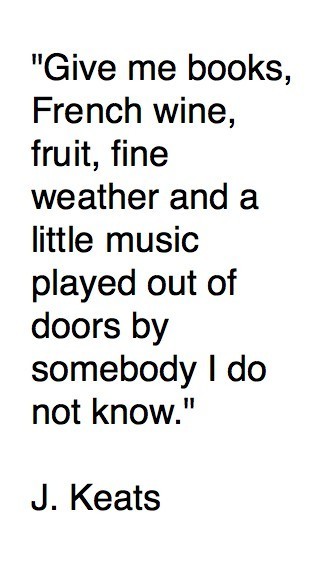
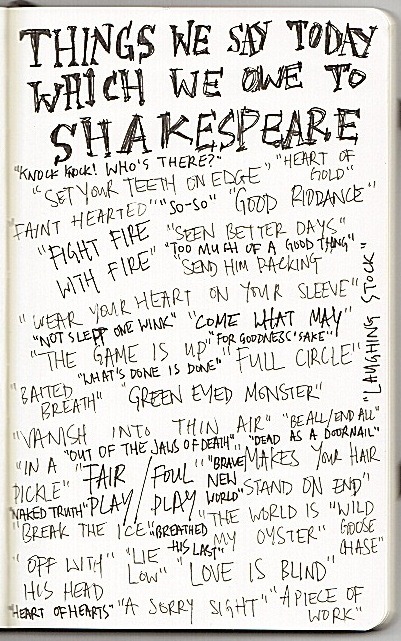
On a quest to find the perfect artwork for my children's school library (small classical school and tiny library), I came across several zingers. This one is probably my favorite because despite my best efforts I still have a crush on Shakespeare.


And isn't this just so incredibly fun?! And I think, "I could make that!...but not right now."


I can't amen this enough!
That John Keats was a true genius. I tell ya.

The next one brings my high school history teacher to mind because he always said it, and all that knew him knew he felt this way in his heart of hearts.


The next one is so true. Some of my very favorite people are dead. Wait...was that socially awkward?


Wish I could beat this into the young school children's heads.


But this is the one I ended up going with because it's just so fun, it's not just a quote but a colorful illustration too, it sort of reminds me of our house, and I found it for sale at a reasonable price. Unfortunately, I had to take the latter into consideration.
Books to the ceiling, Books to the sky, My pile of books is a mile high. How I love them! How I need them! I'll have a long beard by the time I read them. 
~ Arnold Lobel

My thoughts exactly, Mr Lobel... well, except for the bit about the beard.


Monday, November 28, 2011

from 'Sleep and Poetry'

This is a favorite excerpt from the poem Sleep and Poetry by John Keats. These lines inspire me out of everyday doldrums to see life accurately - with all the magic it possesses.

But off Despondence! miserable bane!
They should now know thee, who athirst to gain
A noble end, are thirsty every hour.
What though I am not wealthy in the dower
Of spanning wisdom; though I do not know
The shiftings of the mighty winds that blow
Hither and thither all the changing thoughts
Of man: though no great minist'ring reason sorts
Out the dark mysteries of human souls
To clear conceiving: yet there ever rolls
A vast idea before me, and I glean
Therefrom my liberty; thence too I've seen
The end and aim of Poesy.
~John Keats

Wednesday, September 1, 2010

O for a beaker full of the warm South

Alas, the poetry contests have come to an end. It was fun while it lasted. Now how about that nice ol' chat about John Keats? I hope we have some fans of his out there. His poetry, as well as his letters, are worth the read. For a taste of his humor how about, Give me Women, Wine, and Snuff.

Give me women, wine, and snuff
Until I cry out 'Hold, enough!'
You may do so sans objection
Till the day of resurrection;
For, bless my beard, they aye shall be
My beloved Trinity.
Some of our fellow inhabitants aren't any good at expressing themselves, and some are good at it, but one could do very well with out having them do it, so to speak. Keats doesn't fit into either one of these categories. He says it all with grace and elegance.
When I have fears that I may cease to be
Before my pen has glean'd my teeming brain,
Before high-piled books, in charactery,
Hold like rich garners the full ripen'd grain;
When I behold, upon the night's starr'd face,
Huge cloudy symbols of a high romance,
And think that I may never live to trace
Their shadows, with the magic hand of chance;
And when I feel, fair creature of an hour,
That I shall never look upon thee more,
Never have relish in the faery power
Of unreflecting love;--then on the shore
Of the wide world I stand alone, and think
Till love and fame to nothingness do sink.
Or this one,
If by dull rhymes our English must be chain'd,
And, like Andromeda, the Sonnet sweet
Fetter'd, in spite of pained loveliness;
Let us find out, if we must be constrain'd,
Sandals more interwoven and complete
To fit the naked foot of poesy;
Let us inspect the lyre, and weigh the stress
Of every chord, and see what may be gain'd
By ear industrious, and attention meet:
Misers of sound and syllable, no less
Than Midas of his coinage, let us be
Jealous of dead leaves in the bay wreath crown;
So, if we may not let the Muse be free,
She will be bound with garlands of her own.

His odes are considered his best work. Someone once said his Ode to a Grecian Urn was worth any number of little old ladies. Even if some of us may take umbrage with that statement we cannot deny there is something to it. I am particularly fond of his Ode to a Nightingale.

Ode to a Nightingale
My heart aches, and a drowsy numbness pains
My sense, as though of hemlock I had drunk,
Or emptied some dull opiate to the drains
One minute past, and Lethe-wards had sunk:
'Tis not through envy of thy happy lot,
But being too happy in thine happiness,--
That thou, light-winged Dryad of the trees
In some melodious plot
Of beechen green, and shadows numberless,
Singest of summer in full-throated ease.
O, for a draught of vintage! that hath been
Cool'd a long age in the deep-delved earth,
Tasting of Flora and the country green,
Dance, and Provençal song, and sunburnt mirth!
O for a beaker full of the warm South,
Full of the true, the blushful Hippocrene,
With beaded bubbles winking at the brim,
And purple-stained mouth;
That I might drink, and leave the world unseen,
And with thee fade away into the forest dim-
Fade far away, dissolve, and quite forget
What thou among the leaves hast never known,
The weariness, the fever, and the fret
Here, where men sit and hear each other groan;
Where palsy shakes a few, sad, last gray hairs,
Where youth grows pale, and spectre-thin, and dies;
Where but to think is to be full of sorrow
And leaden-eyed despairs,
Where Beauty cannot keep her lustrous eyes,
Or new Love pine at them beyond to-morrow.
Away! away! for I will fly to thee,
Not charioted by Bacchus and his pards,
But on the viewless wings of Poesy,
Though the dull brain perplexes and retards:
Already with thee! tender is the night,
And haply the Queen-Moon is on her throne,
Cluster'd around by all her starry Fays;
But here there is no light,
Save what from heaven is with the breezes blown
Through verdurous glooms and winding mossy ways.
I cannot see what flowers are at my feet,
Nor what soft incense hangs upon the boughs,
But, in embalmed darkness, guess each sweet
Wherewith the seasonable month endows
The grass, the thicket, and the fruit-tree wild;
White hawthorn, and the pastoral eglantine;
Fast fading violets cover'd up in leaves;
And mid-May's eldest child,
The coming musk-rose, full of dewy wine,
The murmurous haunt of flies on summer eves.
Darkling I listen; and, for many a time
I have been half in love with easeful Death,
Call'd him soft names in many a mused rhyme,
To take into the air my quiet breath;
Now more than ever seems it rich to die,
To cease upon the midnight with no pain,
While thou art pouring forth thy soul abroad
In such an ecstasy!
Still wouldst thou sing, and I have ears in vain--
To thy high requiem become a sod.
Thou wast not born for death, immortal Bird!
No hungry generations tread thee down;
The voice I hear this passing night was heard
In ancient days by emperor and clown:
Perhaps the self-same song that found a path
Through the sad heart of Ruth, when, sick for home,
She stood in tears amid the alien corn;
The same that oft-times hath
Charm'd magic casements, opening on the foam
Of perilous seas, in faery lands forlorn.
Forlorn! the very word is like a bell
To toll me back from thee to my sole self!
Adieu! the fancy cannot cheat so well
As she is fam'd to do, deceiving elf.
Adieu! adieu! thy plaintive anthem fades
Past the near meadows, over the still stream,
Up the hill-side; and now 'tis buried deep
In the next valley-glades:
Was it a vision, or a waking dream?
Fled is that music:--Do I wake or sleep?

Tuesday, August 17, 2010

poetry contest

So what do you win if you correctly guess the poems besides the smashing title of "poetry scholar"? Isn't that enough? Or maybe "poetry expert" would be more to your liking. With a snazzy description like that, you will fit right in with all of the celebrities putting these types of titles after their names.

Lately, I was thumbing through bon appetite magazine and slapped my eyes on, Gwyneth Paltrow actress, lifestyle guru. Not sure what that means, exactly. Perhaps I could say of my daughter- student, organic gardener. She will be going into the fourth grade, and did in fact coax out not a few watermelons this summer.

But I digress, back to the prize. The proud winner of this contest will receive a lovely blue hardback of English Romantic Poetry and Prose. This gem contains not only quite a few selections from Keats, it also features Wordsworth, Sir Walter Scott, Bysshe Shelley, Lord Byron and lots more.

This book has had a previous owner, and therefore has acquired some character all its own. She wrote a note after the title The Sensitive Plant (a poem by Shelley). Her pencil marking reads, is Shelley. So now it says, The Sensitive Plant is Shelley. Am I the only one who thinks this is funny?

There is also a stanza near the back of the book by a Winthrop Mackworth Praed (I don't believe I've had the pleasure.) entitled Stanzas on Seeing the Speaker Asleep in His Chair. Does that not sound great or what?

However, before I get all carried away, I must tell you that there is to be a tie breaker. The winners are, Lydia and Drew, Anna, and Bess. So winners, look over the two poems below and cast your votes again. Attribute one poem to each author or both poems to one. Hopefully, this time to break the tie.

#1
I watched a steady flame up-climb the sky-

(A flame no doing, surely, of my own)
And linger like a sunset in your eye,
(For love it is not possible to own).
If I could climb the jade-bright hills of Mourne,
I might have once wished you forever young
To bring a cup of dew out well forlorn,
For once I wanted beauty, ever sung.
Somewhere twixt a draught of Lethe's cup
'Tween air the honeysuckle tints with sleep,
I caught your sunrise going dancing up,
Now new morn, sleepless nights and days to keep.
I listen for this faerie tune you weave,
Just as you are, the one to never leave.


#2
Time's sea has been five years at its slow ebb,

Long hours have to and fro let creep the sand,
Since I was tangled in thy beauty's web,
And snared by the ungloving of thy hand.
And yet I never look in midnight sky,
But I behold thine eyes' well memoried light;
I cannot look upon the roses dye,
But to thy cheek my soul doth take its flight;
I cannot look on any budding flower,
But my fond ear, in fancy at thy lips,
And hearkening for a love-sound, doth devour
Its sweets in the wrong sense: - Thou dost eclipse
Every delight with sweet remembering,
And grief unto my darling joys dost bring.
Tuesday, August 10, 2010

A thing of beauty is a joy forever

After watching the movie, Bright Star, I was inspired to revisit the poetry of John Keats. It is rather rummy, but I hadn't read Keats for some 5 years! And he really needs to be kept between Austen and Wodehouse on the close and handy shelf that you walk by everyday so that you can, at the very least, smile and wave.

His poems are dream-like without being too dreamy, classical without being stiffish and droll. They are lovely and romantic leaving you feeling joy and inspiration rather than mush.

He is odd in his way, being a Romantic poet that has a moral code, as opposed to Lord Byron and Bysshe Shelley. While Keats nursed his sick brother and caught tuberculosis from him, Byron and Shelley were loving and leaving women left and right. They were great in their way, but were no John Keats.

Keats lived during the time of Jane Austen (how cool is that!), and if either of them had actually moved in larger literary circles, they might've met and read each others work, or at least had interesting discussions. He seemed to share several commonalities with Jane Austen, including dying young and receiving large recognition posthumously.

I'm not exactly sure how accurate Bright Star is. There is, in any biographical movie, some amount of hypothesis that goes on, but it's pretty solid. (And TONS better than that heretical Miss Austen Regrets.)

Here is something for those of you with sporting blood. Read the three poems below and vote which are by Keats and which are by Von Gladden (that's my man). And NO looking on the internet or elsewhere at "first lines" and such! Not even after you vote, let the suspicion hang in the air until we cut it with a knife. Scout's honor! Code of the Woosters! After all votes are in we'll have a nice ol' chat about which John Keats poems are our favorites.

#1
Nature withheld Cassandra in the skies,
For more adornment, a full thousand years;
She took their cream of Beauty, fairest dies,
And shaped and tinted her above all peers:
Meanwhile Love kept her dearly with his wings,
And underneath their shadow filled her eyes
With such a richness that the cloudy Kings
Of high Olympus uttered slavish sighs.
When from the Heavens I saw her first descend,
My heart took fire, and only burning pains,
They were my pleasures--they my Life's sad end;
Love poured her beauty into my warm veins.

#2
You are closer of me than this sunset
Which tosses pink haze among the cold pines,
Closer than music in the rain I find,
Closer than way birds wing to narrow rest.
Finding always the subtle good not there,
The light that strangely floods an empty scene,
And fills with high hope, the cheer of all seen,
Your music rests beside and over, fair.
I cannot turn from you the thanks to give,
You are the heart of my house and give heart
To beginning, middle, and end of this Art,
This being found by new reasons to live.
Court, count Time with me for we shall go
Down a doubly bright path the round sun goes.

#3
The forest greens I wander easily,
And take their beauty in my roving eye -
How the shaggy trees hang with heavy leaves
Like green rain hung silent beneath Time's sighs.
Yet thee I never shall encapture so -
No, more easily silence the woodlands,
Or steal the sweetened scent there o'erblown,
And all about the clinging vines weave bands.
More easily (all impossible!) chain
Up Thy body's beauty in a painting,
Than teach my mind and soul to overtame
Your pure spirit that leaves no Grace wanting.
The gorgeous hummingbird, Thy body like,
Hovers o'er Thy soul's lilies, ever white.