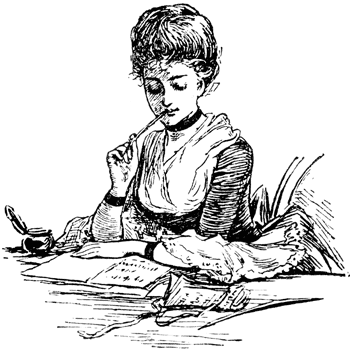
 Jane Austen wrote her Plan of a Novel According from Hints from Various Quarters in 1816. I believe she was inspired by Mr Clarke (the Prince Regent's librarian and personal chaplain) who had given her suggestions on what her next novel should consist of. He took a bit of umbrage at the portrayal of Mr Collins no doubt. He wrote,
I also, dear Madam, wished to be allowed to ask you to delineate in some future Work the Habits of Life and Character and enthusiasm of a Clergyman -- who should pass his time between the metropolis& the Country... -- Fond of and entirely engaged in Literature...JA answered his letter and suggestion not quite truthfully. For she was far from ignorant, was versed in French, and was well-read.
I am quite honoured by your thinking me capable of drawing such a clergyman as you gave the sketch of... But I assure you I am not. The comic part of the character I might be equal to, but not the good, the enthusiastic, the literary. Such a man's conversation must be on subjects of science and philosophy, of which I know nothing; or must occasionally be abundant in allusions and quotations which a woman who, like me,knows only her mother tongue, and has read very little in that, would be totally without the power of giving. A classical education, or at any rate a very extensive acquaintance with English literature, ancient and modern, appears to me quite indispensable for the person who would do justice to your clergyman; and I think I may boast myself to be, with all possible vanity, the most unlearned and ill-informed female who ever dared to be an authoress.In his biography of his aunt, James Edward Austen-Leigh confided,
Mr. Clarke, however, was not to be discouraged from proposing another subject. He had recently been appointed chaplain and private English secretary to Prince Leopold, who was then about to be united to the Princess Charlotte; and when he again wrote to express the gracious thanks of the Prince Regent for the copy of Emma which had been presented, he suggests that 'an historical romance illustrative of the august House of Cobourg would just now be very interesting,' and might very properly be dedicated to Prince Leopold. This was much as if Sir William Ross had been set to paint a great battle-piece; and it is amusing to see with what grave civility she declined a proposal which must have struck her as ludicrous.In a letter dated 4 months from the last, she wrote,
You are very kind in your hints as to the sort of composition which might recommend me at present, and I am fully sensible that an historical romance, founded on the House of Saxe Cobourg, might be much more to the purpose of profit or popularity than such pictures of domestic life in country villages as I deal in. But I could no more write a romance than an epic poem. I could not sit seriously down to write a serious romance under any other motive than to save my life; and if it were indispensable for me to keep it up and never relax into laughing at myself or other people, I am sure I should be hung before I had finished the first chapter. No, I must keep to my own style and go on in my own way; and though I may never succeed again in that, I am convinced that I should totally fail in any other.
She confessed that "pictures of perfection make me sick and wicked" and had a bit of fun when composing her Plan of a Novel According from Hints from Various Quarters. Hope you enjoy it!
SCENE to be in the Country, Heroine the Daughter of a Clergyman, one who after having lived much in the World had retired from it and settled in a Curacy, with a very small fortune of his own. -- He, the most excellent Man that can be imagined, perfect in Character, Temper, and Manners -- without the smallest drawback or peculiarity to prevent his being the most delightful companion to his Daughter from one year's end to the other. -- Heroine a faultless Character herself, -- perfectly good, with much tenderness and sentiment, and not the least Wit -- very highly accomplished, understanding modern Languages and (generally speaking) everything that the most accomplished young Women learn, but particularly excelling in Music -- her favourite pursuit -- and playing equally well on the PianoForte and Harp -- and singing in the first stile. Her Person quite beautiful -- dark eyes and plump cheeks. -- Book to open with the description of Father and Daughter -- who are to converse in long speeches, elegant Language -- and a tone of high serious sentiment. -- The Father to be induced, at his Daughter's earnest request, to relate to her the past events of his Life. This Narrative will reach through the greatest part of the first volume -- as besides all the circumstances of his attachment to her Mother and their Marriage, it will comprehend his going to sea as Chaplain to a distinguished naval character about the Court, his going afterwards to Court himself, which introduced him to a great variety of Characters and involved him in many interesting situations, concluding with his opinions on the Benefits to result from Tithes being done away, and his having buried his own Mother (Heroine's lamented Grandmother) in consequence of the High Priest of the Parish in which she died refusing to pay her Remains the respect due to them. The Father to be of a very literary turn, an Enthusiast in Literature, nobody's Enemy but his own -- at the same time most zealous in discharge of his Pastoral Duties, the model of an exemplary Parish Priest. -- The heroine's friendship to be sought after by a young woman in the same Neighbourhood, of Talents and Shrewdness, with light eyes and a fair skin, but having a considerable degree of Wit, Heroine shall shrink from the acquaintance. From this outset, the Story will proceed, and contain a striking variety of adventures. Heroine and her Father never above a fortnight together in one place, he being driven from his Curacy by the vile arts of some totally unprincipled and heart-less young Man, desperately in love with the Heroine, and pursuing her with unrelenting passion. -- No sooner settled in one Country of Europe than they are necessitated to quit it and retire to another -- always making new acquaintance, and always obliged to leave them. -- This will of course exhibit a wide variety of Characters -- but there will be no mixture; the scene will be for ever shifting from one Set of People to another -- but All the Good will be unexceptionable in every respect -- and there will be no foibles or weaknesses but with the Wicked, who will be completely depraved and infamous, hardly a resemblance of humanity left in them. -- Early in her career, in the progress of her first removals, Heroine must meet with the Hero -- all perfection of course -- and only prevented from paying his addresses to her by some excess of refinement. -- Wherever she goes, somebody falls in love with her, and she receives repeated offers of Marriage -- which she refers wholly to her Father, exceedingly angry that he should not be first applied to. -- Often carried away by the anti-hero, but rescued either by her Father or by the Hero -- often reduced to support herself and her Father by her Talents and work for her Bread; continually cheated and defrauded of her hire, worn down to a Skeleton, and now and then starved to death. -- At last, hunted out of civilized Society, denied the poor Shelter of the humblest Cottage, they are compelled to retreat into Kamschatka where the poor Father, quite worn down, finding his end approaching, throws himself on the Ground, and after 4 or 5 hours of tender advice and parental Admonition to his miserable Child, expires in a fine burst of Literary Enthusiasm, intermingled with Invectives against holders of Tithes. -- Heroine inconsolable for some time -- but afterwards crawls back towards her former Country -- having at least 20 narrow escapes from falling into the hands of the Anti-hero -- and at last in the very nick of time, turning a corner to avoid him, runs into the arms of the Hero himself, who having just shaken off the scruples which fetter'd him before, was at the very moment setting off in pursuit of her. -- The Tenderest and completest Eclaircissement takes place, and they are happily united. -- Throughout the whole work, Heroine to be in the most elegant Society and living in high style. The name of the work not to be Emma, but of the same sort as S. & S. and P. & P.
