Showing posts with label End of the Affair. Show all posts

Friday, January 21, 2011

Greeneland


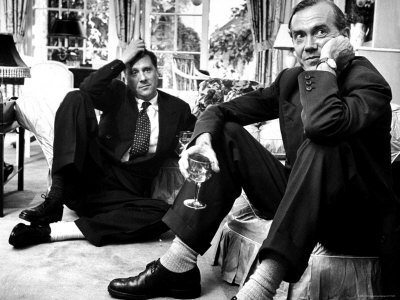
After just putting down, The Ministry of Fear, This Gun For Hire, and The Confidential Agent, I am once again reminded of what a compelling character this Graham Greene fellow is. He objected to being called a Catholic novelist, preferring to be called a novelist who happened to be Catholic. Most of his works are not religious in character although four are considered his 'religious novels'- The Power and the Glory, The End of the Affair, Brighton Rock, and The Heart of the Matter. Several of his earlier works put me in mind of 'spy stories' or 'thrillers' (though he described them as 'entertainments'). These stories are often set with war looming in the background. His books also remind me of Russian novels in that he deals with the internal struggle, as well as the need for physical survival. With many of his characters you feel as if you've seen into their soul, and perhaps can see your own more clearly. After reading Graham Greene, expect to feel guilty, dirty, and pure. Depressed, saddened, elated- spiritual & earthy- a deep sense of joy and the need to pray.

Graham Greene is able to portray struggles quite convincingly, perhaps because of and in spite of his own. He suffered from bipolar disorder, and once told his wife that he had "a character profoundly antagonistic to ordinary domestic life", and that "unfortunately, the disease is also one's material". He later separated from his wife, though never divorcing her. His first really successful novel was Stamboul Train (1932), which was later adapted as the film Orient Express (1934). He had many other such successes. Other items of interest include his recruitment by MI6, and his friendship with his neighbor Charlie Chaplin.

Greene is noted for a criticism he made of E. M. Forster and Virginia Woolf for not depicting the religious sense in which characters struggle. He stated that the result were characters who "wandered about like cardboard symbols through a world that is paper-thin". Greene often portrayed his characters grappling with the struggles of the soul. Something which Jane Austen masterfully portrayed, which Henry James showed somewhat.

Greene had his own struggles in life, angering some Catholics, while making others proud. The religious themes of his novels may be said to have taken a more humanistic tone in the latter part of his career, and he had no qualms with stating his political views. Despite this, he enjoyed having a bit of humor in his life, so when the the New Statesman held a contest for parodies of Greene's writing style, he submitted an entry under the pen name "N. Wilkinson" and won second prize.

Graham Greene once wrote of his Chiapas travels when he had taken shelter in a hut- 'a storehouse for corn, but it contained what you seldom find in Mexico, the feel of human goodness'. The man living in the hut gave Greene his bed, which was a 'dias of earth covered with a straw mat set against the mound of corn where the rats were burrowing...All that was left was an old man on the verge of starvation living in a hut with the rats, welcoming the strangers without a word of payment, gossiping gently in the dark. I felt myself back with the population of heaven.' Blessed are the poor in spirit: for theirs is the kingdom of heaven.

Three By Graham Green (The Ministry Of Fear, The Confidential Agent & This Gun For Hire)

Tuesday, August 3, 2010

I don't see that you have a problem

After watching only a few episodes of the popular show, House, you can get a pretty good sampling of how the "religious person" is portrayed in today's TV and movies. A priest that doesn't really believe in God sees a vision of Christ after downing too many glasses of Scotch. A boy who claims to speak with God and claims virginity turns out to have an STD, and anyone claiming to have any faith at all probably won't make it long in this evolved world of reason. At best (which is really worse, but the writers feel they're throwing us a bone) the "person of faith" is weak and insipid, believing in a God that is neither all-knowing, all-powerful, or all-loving, in short- a sappy Jesus who they just wouldn't feel comfortable forcing on anyone. And this is supposed to be the typical Christian that we identify with.

So I was quite surprised (although this movie is older, which I suppose is in its favor in this respect) when watching The End of the Affair (with Deborah Kerr, the newer version is absolute rubbish) that the movie makers actually stuck w/ Graham Greene's spirit of the story! (He wrote the book that the movie is based on.) The priest in this movie who Sarah goes to for guidance is quite impressive for a movie priest.

Looking at the title you might think this movie is about an affair, but that's not quite the gist. It's about hating a God you don't believe in. The affair is the back-drop, the situation that forces the characters to see their souls for what they really are. It all begins with Maurice stating, "This is a record of hate far more than of love."

SCENE 1: A small party at the Miles's to which Maurice in invited. Enter stage left, Henry. Henry Miles, the mild-mannered civil servant who in all likelihood wouldn't hurt a fly. (This most resembles the "Christian character" in House and the like. And in some parts of the story reminiscent of Wilson.) When Henry is pressed by his wife, "Henry, do you pray? Henry, what do you believe?" He responds with, "It's quite simple, really. One does one's best." And there you have it in a nutshell, folks.

The Dr House-like character in this movie would be both Bendrix and Smythe. Richard Smythe is a "soap box orator" that is "mad at God" as Sarah tells Bendrix. (She refers to the air raids, bombs and war, and states that "it seems like a dangerous time to be mad at God".)

Bendrix responds, "Hurling thunderbolts? It's like walking under ladders. Come, you don't really believe all that do you?"
"No, but I don't walk under ladders either."

You can either watch the movie or read the book, but Graham Greene shows how painful and unwelcome a belief in God is for Sarah (and later for Bendrix and Smythe). After his rooms are bombed, Sarah makes a promise that she doesn't want to keep to a God she doesn't believe in. She tells the priest, "I promised that if God gave him back his life, I mean make him not be dead, I wouldn't be with him again." To which the priest responds, "I don't see that you have a problem. If you made a vow to someone that you don't believe in, why keep it?" Sarah tells him, "If there is a God, then he put the idea (of the promise) into my head, and I hate Him for it!"

Not to give the entire story away, but Sarah has a few conversations with said priest. Once she asks him, "God. Always God. Can you priests say nothing else?" He tells her, "There is nothing else."

As I said, you must see it for yourself, but I'll give a bit away by saying that Sarah 'remembers her baptism' and near the end she tells Smythe,

"You helped me to find God. You taught me to believe in Him."
"I taught you?"
"By your hate. Richard, you can't hate something who isn't there."
"It's easy for you to accept the idea of God, you have no complaint. But why should I love a God who let me be born with this?"
(note: He looks a bit like two-face, and that's what he's referring to here.) This is when it dawns on Sarah.
"Oh my dear Richard, your belief is far deeper than mine." (Smythe's physical pain, and reaction to it, puts one in mind of House.)

At the end Maurice has Sarah's diary and reads her thoughts,

"I'm praying to God all the time that He won't be hard. And I've learned that you must pray the way you make love- with everything you have. I believe there is a God. I believe the whole bag of tricks, there is nothing I don't believe. I've fallen into belief the way I fell in love. I've never loved anyone as I love you (Maurice), and I've never believed in anything as I believe now. Maurice dearest, you were on His side all the time without knowing it. You hated in me the things He hates...You are apart of this, Maurice. Just as you are apart of me and we are apart of God."

To read about another priest (though not quite as stellar) of Graham Greene's creation, read The Power and The Glory which is, in fact, more excellent.