Showing posts with label Catholic. Show all posts

Sunday, January 13, 2013

The Sacrament of the Present Moment

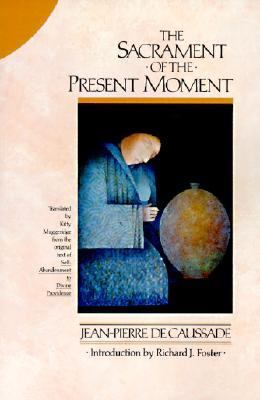
Book review time! This is the book you need to read to start the new year.  It's very understandable, easy to read, and is about 100 pages. (I now rate the shortness of a book as a quality not to be underestimated.) The Sacrament of the Present Moment (also translated as Abandonment to Divine Providence) written by a French Jesuit priest, Jean-Pierre de Caussade (1675-1751), is a compilation of notes that Caussade wrote to the Nuns of the Visitation of whom he was the spiritual director. When reading this type of book I read slowly, trying to soak it in. There were times when I just put the book down because my mind and heart were full and I needed to meditate on what I'd read before going on. That's a sign of a good book!

Along with some of my other ideas, my view of time was challenged for within the pages of this short book we are reminded that the Scriptures are still being written, that God is working in every moment, and that we ought to have no concern but for the present moment.

To find contentment in the present moment is to relish and adore the divine will in the succession of all the things to be done and suffered which make up the duty of the present moment. p64

If what God has ordained especially for us does not satisfy us, where else shall we turn? If we do not relish what the Holy Spirit prepares for us, what food would not be tasteless to so depraved a palate? Our souls can only be truly nourished, strengthened, enriched and sanctified by the bounty of the present moment. p81

Is not all time a succession of the consequences of that divine action which pervades and fills and transfigures everything? p70

...time is but the history of divine action! p100

Caussade reminds us that we have nothing to fear, to fret over, to regret. All that is required is faith. There is a potent reminder of C.S. Lewis' Till We Have Faces in this book as Caussade discusses faith and fear, especially Lewis' Die before you die. There's no chance after.

The Love of God, submission to his divine action; that is what is necessary to sanctify souls, that is all that is required of them; and their faithfulness in responding to it is what gives them grace. p25

The more confused their situation, the better the charm works and the heart says, 'All will be well!' All is in God's hands, there is nothing to fear. Fear itself, suspense, desolation, are verses in the hymns of the night. We rejoice in not omitting a single syllable, for we know they all end in 'Glory be to God!' Thus we find our way by losing it. p95

Psyche was brought to mind as I read,  

Everything in the present moment tends to draw us away from the path of love and passive obedience. It requires heroic courage and self-surrender to hold firmly to a simple faith and to keep singing the same tune confidently while grace itself seems to be singing a different one in another key, giving us the impression that we have been misled and are lost. But if only we have the courage to let the thunder, lightning and storm rage, and to walk unfaltering in the path of love and obedience to the duty and demands of the present moment, we are emulating Jesus himself. p53

Faith is the light of time, it alone recognizes truth without seeing it, touches what it cannot feel, looks upon the world as though it did not exist, sees what is not apparent. p103

Orual was also in my thoughts as the contrast between her and Psyche is so stark.

How is it that, being continually reminded that everything that happens in the world is but a shadow, an image, the mystery of faith, we persist in relying only on our human faculties, and continue to interpret the merely temporal aspect of the unanswerable enigma of our existence? p102

Lewis' story is so powerful because it reminds us of the fantastical tale that God is writing. A tale mysterious, strange, unpredictable in which we are the characters. God loves mystery, our only option is to trust Him completely. Caussade says

 All are the subject of mystical tales far more beautiful and amazing than any invented by the crude imagination of mortal men... The terrifying objects put in our way are nothing. They are only summoned in order to embellish our lives with glorious adventures. p24

What perfection comes from this mysterious influence whose subject and instrument we are, and of whose existence we are not even conscious so much it does it seems to be part of what we do of our own accord!...Never knowing what is urging them on, the most divine impulses trouble them. Despising all they do, they admire what is done by others and feel themselves to be far inferior. To rely on their own efforts to overcome these apparent faults is futile, for they are God's admirable plan to force them to depend entirely on his help. p40

Follow your path without a map, not knowing the way, and all with be revealed to you. Seek only God's kingdom and his justice through love and obedience, and all will be granted to you....Remain at peace, united to God in love, and continue blindly along the straight and narrow path of duty. The angels are beside you in this dark night, their arms around you. Should God require more of you he will make it known. p57

In Jane Austen's Persuasion Anne's friend, Mrs Smith is described thus, A submissive spirit might be patient, a strong understanding would supply resolution, but here was something more, here was that elasticity of mind, that disposition to be comforted, that power of turning readily from evil to good, and of finding employment which carried her out of herself, which was from nature alone. This description has been a goal for me and Caussade's book takes the idea and expands it in an accessible way.

The first duty required of souls is self-discipline; the second is self-surrender and complete passivity; the third requires great humility, a humble and willing disposition and a readiness to follow the movement of grace which motivates everything if they simply respond willingly to all its guidance. p59

Do what you are doing, suffer what you are suffering, only your heart need be changed. It will cost you nothing, for this change only consists in desiring everything that God ordains. Yes, holiness is a will disposed to conform to God's. And what can be easier? Since who can resist adoring a will so loving and so good? This love alone makes everything divine. p61

In fact, he believes ...there is nothing easier, more ordinary, more available to all than saintliness. p6

HERE is the link to the book. If you find New Year's resolutions unattractive, then consider a "present moment" resolution to Let God's will be done; obey him in everything, each one according to his capacity. Nothing is easier in the spiritual life, nothing more available to all. p100 
 

Saturday, May 5, 2012

plus potuit, quia plus amavit


Just finished The Privilege of Being a Woman by Alice von Hildebrand and wanted to dash off a few lines in ref. Perhaps, before we go any further, I should just mention that I am not a member of the Catholic church. There is no need to be Catholic to see eye to eye with this lady on not-a-few issues, her book is inspiring and a pleasure to read. Fairly early on in the proceedings von Hildebrand waggles a finger at the modern school of thought (which carelessly talks of the "emancipation" of women, but really means the "masculinization" of women) and I like to stand by and look smug whenever that's being done. Plus, she does sum it up rather well,
Unwittingly, the feminists acknowledge the superiority of the male sex by wishing to become like men. They foolishly want to alter inequality rather than to achieve truth or justice. (p10)

The fashions of the day are all geared toward destroying women's sensitivity for the dignity of their sex. (p90)
This book is refreshing because she upholds womanhood - not because women are the best or that we are strong in ourselves or because we are simply united in an earthly way - but because God holds up women and has given us many graces and privileges. She also reminds us that motherhood isn't a lowly harangue:
...in the light of redemption (which has given a sublime meaning to suffering), to suffer agony to bring another human being into the world is a premonition of the sufferings of Christ whose blood has redeemed us. (p16)
One day, all human accomplishments will be reduced to a pile of ashes. But every single child to whom a woman has given birth will live forever, for he has been given an immortal soul made to God's image and likeness. In this light, the assertion of de Beauvoir that "woman produces nothing" becomes particularly ludicrous. (p33)

Just as Christ has suffered the agonizing pains of the crucifixion in order to reopen for us the gates of heaven, so the woman has received the costly privilege of suffering so that another child made in God's image and likeness can enter into the world... Chesterton writes, "No one staring at the frightful female privilege, can quite believe in the equality of the sexes..." (p87)
The best part of the book, though, is when she touches on weakness or perceived weakness. This "weakness" includes humility, chastity, modesty, self-sacrifice, and service.
 ...Nietzsche's philosophy in a nutshell - the glorification of strength and the denigration of weakness - has become the shallow core of modern thought and feminist belief. (p23)
...secularistic view is the claim that 'service is degrading'... It is humiliating. (p31)

Modern ideology wages war on the Gospel which teaches humility and that those that lower themselves will be exalted. (p32)

Women are more geared to piety because they have a keener awareness of their weakness. This is their true strength. (p66)

And, of course, von Hildebrand brings forth the most excellent example of Mary the Mother of Jesus. She points us to Mary who was a woman who was not passive, but receptive: "be it done to me according to Thy word".
...women are called upon to imitate Mary's virtues: first and foremost, her radiant humility. (p99)
There were, as with any work, statements I would debate. For example, I would disagree with the authoress on the point she made that Mary's womb was too holy after the birth of Jesus to consummate her marriage with Joseph. But there are many gems in this short (small book, 100 pages) read.

Some other authors she quotes:
...if all knees should bend in front of the Saviour, all heads should bow in front of His mother. (Gueranger)

un peuple vaut ce que valent ses femmes (Vinet)
the value of a people is to be gauged by the value of its women

Where the woman is faithful, no evil can befall. The woman is the root and the man the tree. The tree grows only as high as the root is strong. (Confucius)
The artist who no longer gives God the honor, and instead proclaims only himself, must, by excluding the religious element from culture, practically eliminate also its womanly quality. (Gertrud von le Fort, speaking on modern art)
I hate all talk about the emancipation of women...for once [man] has made her believe that she is entirely in his power, at the mercy of his will, she can be nothing for him except a prey to his whims, whereas as woman, she can be everything for him. (Kierkegaard)

For even the Son of Man did not come to be served, but to serve, and to give His life a ransom for many. (Mark 10:45)

plus potuit, quia plus amavit (Saint Gregory)
having the stronger love, she had the stronger power

random reading


Here, in no order at all, are some blog posts I've enjoyed lately:

http://www.armenianbiblechurch.org/food%20corner/saturation%20love.htm

http://www.stacymakescents.com/food-is-not-your-god

http://www.thehealthyhomeeconomist.com/five-fats-you-must-have-in-your-kitchen/

http://kateelizabethconner.com/ten-things-i-want-to-tell-teenage-girls/

http://www.pinkpeppers.com/2012/03/26/the-magical-technique-to-raising-wonderful-children/

http://frigatetoutopia.blogspot.com/2012/03/first-impressions-of-2011-jane-eyre.html

http://www.ncregister.com/blog/simcha-fisher/prayers-answered-darn-it/

http://www.jasna.org/persuasions/on-line/vol20no1/rogers.html

http://www.jasna.org/persuasions/on-line/vol28no1/emsley.htm

http://thepioneerwoman.com/homeschooling/2010/03/why-i-homeschool-and-what-my-approach-is/

http://www.jasna.org/persuasions/on-line/vol29no1/fuller.html

Friday, January 21, 2011

Greeneland


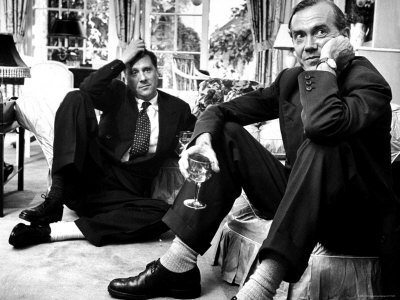
After just putting down, The Ministry of Fear, This Gun For Hire, and The Confidential Agent, I am once again reminded of what a compelling character this Graham Greene fellow is. He objected to being called a Catholic novelist, preferring to be called a novelist who happened to be Catholic. Most of his works are not religious in character although four are considered his 'religious novels'- The Power and the Glory, The End of the Affair, Brighton Rock, and The Heart of the Matter. Several of his earlier works put me in mind of 'spy stories' or 'thrillers' (though he described them as 'entertainments'). These stories are often set with war looming in the background. His books also remind me of Russian novels in that he deals with the internal struggle, as well as the need for physical survival. With many of his characters you feel as if you've seen into their soul, and perhaps can see your own more clearly. After reading Graham Greene, expect to feel guilty, dirty, and pure. Depressed, saddened, elated- spiritual & earthy- a deep sense of joy and the need to pray.

Graham Greene is able to portray struggles quite convincingly, perhaps because of and in spite of his own. He suffered from bipolar disorder, and once told his wife that he had "a character profoundly antagonistic to ordinary domestic life", and that "unfortunately, the disease is also one's material". He later separated from his wife, though never divorcing her. His first really successful novel was Stamboul Train (1932), which was later adapted as the film Orient Express (1934). He had many other such successes. Other items of interest include his recruitment by MI6, and his friendship with his neighbor Charlie Chaplin.

Greene is noted for a criticism he made of E. M. Forster and Virginia Woolf for not depicting the religious sense in which characters struggle. He stated that the result were characters who "wandered about like cardboard symbols through a world that is paper-thin". Greene often portrayed his characters grappling with the struggles of the soul. Something which Jane Austen masterfully portrayed, which Henry James showed somewhat.

Greene had his own struggles in life, angering some Catholics, while making others proud. The religious themes of his novels may be said to have taken a more humanistic tone in the latter part of his career, and he had no qualms with stating his political views. Despite this, he enjoyed having a bit of humor in his life, so when the the New Statesman held a contest for parodies of Greene's writing style, he submitted an entry under the pen name "N. Wilkinson" and won second prize.

Graham Greene once wrote of his Chiapas travels when he had taken shelter in a hut- 'a storehouse for corn, but it contained what you seldom find in Mexico, the feel of human goodness'. The man living in the hut gave Greene his bed, which was a 'dias of earth covered with a straw mat set against the mound of corn where the rats were burrowing...All that was left was an old man on the verge of starvation living in a hut with the rats, welcoming the strangers without a word of payment, gossiping gently in the dark. I felt myself back with the population of heaven.' Blessed are the poor in spirit: for theirs is the kingdom of heaven.

Three By Graham Green (The Ministry Of Fear, The Confidential Agent & This Gun For Hire)