http://www.desiringgod.org/
It really is all about perspective, isn't it?
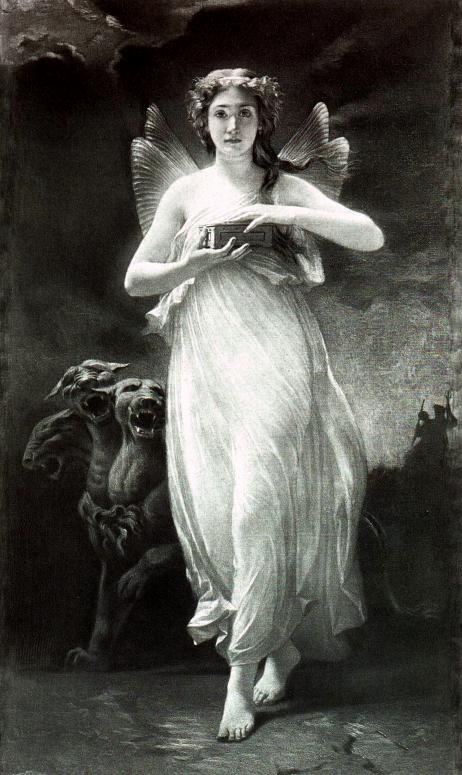
 , C. S. Lewis's greatest work of fiction, is the deepest and most layered of his books, and was also Lewis's favorite of his own works. But it is also a very simple myth, a retelling of the myth of Cupid and Psyche. Manganiello says, For Lewis the “grand miracle” of Christianity is its character of a “true myth” that merits our “imaginative embrace.” This myth surprises Orual by the joy of its truth in the Person she meets face to face at the end of her life.
  , with Val Kilmer, and the quote, "It takes three miracles to make a saint." Psyche 1) sacrifices herself to the "Brute", she 2) sacrifices, at Orual's demand, her husband's trust in her, and 3) she goes through Hades to get beauty for Orual. When Orual goes to see Psyche after her first sacrifice, Psyche tries to explain to Orual what has happened. "You won't understand the wonder and glory of my adventure unless you listen to to bad parts." After Psyche endeavors to make Orual understand the true nature of her marriage to the god of the mountain Orual responds, "If this is true, I've been wrong all my life, everything has to be begun over again." There were many times when the truth was there for her to see, but she "put it aside" (ch. 14). Orual begs her sister to return with her, to which Psyche responds, "No, no, Maia. I can't come back to you. How could I? But you must come to me." (ch. 11) She explains the nature of her husband, "Don't you think a dream would feel shy if it were seen walking about in the waking world?"
To her great surprise Orual learns that she “bore the anguish” while Psyche “achieved the tasks” (312) of sorting seeds of grain, acquiring golden wool, fetching a cup of water, and descending to the Deadlands. By sharing these seemingly unbearable burdens, Orual anticipates the kenosis, or self-emptying of Christ (cf. Phil. 2:5–11), that Hopkins called “the great sacrifice.”
Orual marvels at how this “way of exchange” or substitution can render any one happy. But this is precisely what she witnesses: Psyche “was merry and in good heart. I believe, from the way her lips moved, she was singing” (310–311). Psyche’s actions resonate with the key notes of the Old Testament song of the suffering servant. Her naturally Christian soul prepared for its great mission from the time in her youth that she showed compassion for the people of Glome in their pain. As Orual tells her, “You healed them, and blessed them, and took their filthy diseases upon yourself” (47).
Psyche’s willingness to be purified by a series of trials prefigures the great self-offering of Jesus, who “for the joy set before him, endured a cross” (Heb. 12:2). Since the god advises Orual, “You also shall be Psyche,” she is set to experience the same blessedness that results from partaking of the divine nature (2 Pet. 1:4) or from “atonement.”...
This central paradox also operates in the powerful closing scene of the novel, in which Orual sees the “most dreadful, the most beautiful” face of the god of the mountain. “Even the love between the sexes,” to quote Lewis, “is, as in Dante, ‘a lord of terrible aspect.’” By participating in Psyche’s sufferings (cf. Col. 1:24), then, Orual begins to see the “terrible beauty” of justice tempered by mercy and fulfilled in love.
There is no overt reference to Christ in Till We Have Faces; in fact, there is not even any reference to Hebrew monotheism. But there is a clear reference to Eros, the "Brute" bridegroom of Psyche. (In Christian tradition, the divine bridegroom is Christ: "...as the bridegroom rejoiceth over the bride, so shall thy God rejoice over thee," Isaiah 62.5.) Just before Orual's transfiguration, she heard voices say "He is coming. The god is coming to his house. The god comes to judge Orual." Suddenly "The air was growing brighter and brighter about us; as if something had set it on fire. Each breath I drew let into me new terror, joy, overpowering sweetness. I was pierced through by the arrows of it." "The only dread and beauty there is was coming, was coming." This echoes Dante's experience at the end of Paradise: "So my mind hung in abeyance, staring fixedly, immovable, intent, its ardor increasingly enflamed by the sight. Anyone who sees that Light becomes a person who would not possibly consent to turn away to any other sight; for the good that is the object of all desires is ingathered there in its fullness, and elsewhere it falls short of its perfection...For Orual (and C. S. Lewis), the answer is an encounter with divinity himself. At the end of her adventures, Orual realizes that before the face of God all questions die away and even all words die away.


 , my thought was, "I can't believe I haven't picked it up before now!" It's a short, noteworthy, excellent read. And I hear there's talk of a movie adaptation. http://thegospelcoalition.org/blogs/justintaylor/2011/04/28/an-interview-with-n-d-wilson-on-screenwriting-the-great-divorce/

 . Rowling states, "Grimble is one of funniest books I've ever read, and Grimble himself, who is a small boy, is a fabulous character. I'd love to see a Grimble film." I've only just finished reading Grimble and Grimble at Christmas
 to my children, and they seemed to like it so so. I can see the appeal in Grimble, and understand what Rowling means, but the story does seem a bit flat and the secondary characters are very secondary, meaning you hardly get to know them at all. Clement Freud writes in the same manner as Roald Dahl, and one is constantly reminded of Dahl by the illustrations of Quentin Blake in Grimble. However, Grimble does not, in my opinion, possess the same magic of the stories of Dahl and Rowling. Grimble was a fun read, several funny parts, but not near enough, and in need of stronger characters. What do you think of it?

 , and the thing that struck me was that more than any of her other characters JA shares Henry Tilney's sense of humor. I can readily imagine her making the same spirited and humorous replies as he makes. And, indeed, we do hear her make them in her letters. I can't imagine Henry Tilney saying anything that would displease his creator. Although, JA said that Darcy and Edmund Bertram were her favorites, I am sure she would've laughed a great deal with Henry. Perhaps that is why he is named after her favorite brother?

 . Interesting name, I know. I usually omit the food coloring. There could not be an easier recipe for the result and it is so versatile. Cut it into bite-size squares for a party, eat it right out of the pan with a spoon (not that I've ever been guilty of that), or cut into diamonds and place on a chocolate drizzled plate for something stunning.


 . Books we read as children impact us and can shape our ideas, and knowing that this book meant something to Rowling as a child interested me. I've just finished reading it to my children and they give it a two thumbs up. I noted some things in Manxmouse which Rowling may have added to the "compost pile in her head" (as she calls it).
 site, and came across this the other day. So, I do not take credit for the following. Find it here. She says,
 , contain some of the best-loved lines from my favorite-est Shakespeare play ever! Enjoy. (This is not the official video.)
(Saint Patrick's Breastplate is a Christian hymn whose original Old Irish lyrics were traditionally attributed to Saint Patrick during his Irish ministry in the 5th century.)